|
||||
|
In this Update:
Drill, Baby, Drill? Legalizing Recreational Marijuana? Ask PA Budget Secretary????
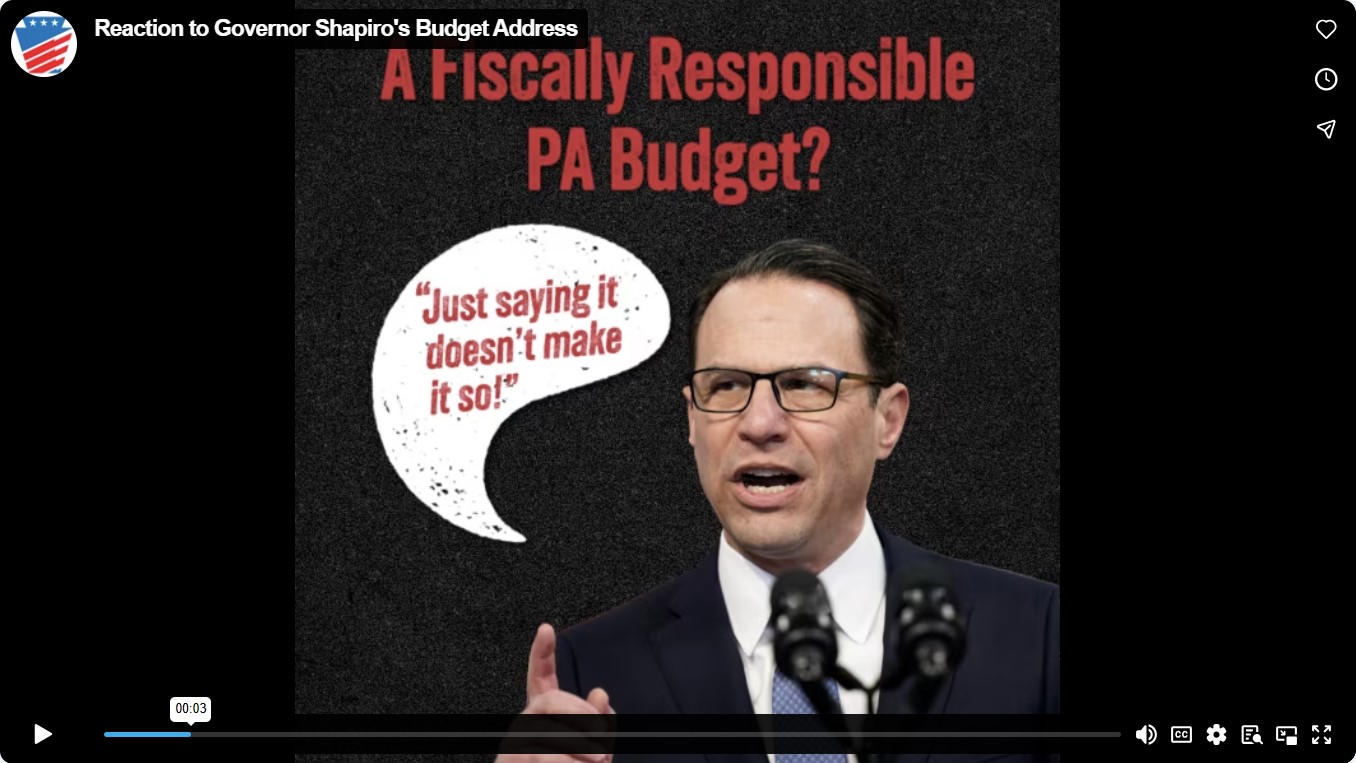
The Senate Appropriations Committee wrapped up two weeks of public hearings on Gov. Josh Shapiro’s proposed $53.5 billion spending plan, which would increase spending by $2.7 billion, or 5.4%. Article 8, Section 12 of the Pennsylvania Constitution clearly establishes that the governor and his agencies are required to provide a financial plan for not less than the next succeeding five fiscal years. These financial plans must realistically include projected expenditures for capital projects, specifically itemized by purpose, and the proposed sources of financing. Every year since I’ve been on the Senate Republican Appropriations Committee, we have asked each agency to show those projections. Every year, we get frustrating excuses and standard “I Don’t Know, Ask the Budget Secretary” responses about why those projections cannot be provided. During the hearing with the Budget Office and Department of Revenue, I asked PA Budget Secretary Zach Reber why the Budget Office/PA Department Revenue have once again failed to produce five-year projections for future Commonwealth expenditures—despite the clearly stated Constitutional requirements? Unfortunately, his insufficient answers were no more enlightening or substantive, than his failure to answer my previous question on why the Shapiro administration refuses to allow open drilling on state lands to serve as an abundant revenue source for Pennsylvania’s Orphan Well Plugging fund? In my second round of questioning, I asked both Budget Secretary Reber and PA Revenue Secretary Pat Browne whether they were aware of any states where the societal and law enforcement costs of legalizing recreational marijuana do not exceed collected tax revenue for “legalized” marijuana sales? Of course, they offered no concrete examples of other states, or even cities, that are prospering due to legalizing recreational marijuana. They also neglected to mention that states with legalization also face increasing homelessness, youth drug use, and criminal activity linked to high-potency marijuana. During the PA Department of Education state budget hearing, I sought on the record details concerning a fraud investigation involving a pre-k education vendor and the rationale behind a massive, proposed spending increase for school meal programs. I concluded my first round of questioning by asking Secretary Carrie Rowe, Ed.D., to justify why the astronomically expensive and extremely ineffective State Board of Higher Education should not be repealed by the Legislature. The governor is proposing nearly $19.4 billion in funding for the Department of Education, an increase of $914 million, or nearly 5 percent—at a time when Local Property Taxes Are Climbing, Despite Growing School District Reserves. The Department of Education is the second-highest spending agency in state government. The largest proposed increase for the Department is for the Ready To Learn Block Grant program, which would rise by $565 million, a 40% increase. Supporting Transportation Investments For All 67 Counties—Not Just SEPTA Serious concerns were also raised about PennDOT’s questionable management of public transit and infrastructure projects, with Senate Republican Appropriation Committee members pressing the agency not only on project oversight but also on the growth of funding held in certain accounts and the lack of transparency surrounding how those dollars are being spent. In the interest of maximum fiscal transparency, I asked Pennsylvania Transportation Secretary Michael Carroll to clarify what PennDOT means by near-term, mid-term and long-term projects when accumulating funds in the Public Transportation Trust Fund (PTTF). Regardless of the Transportation Secretary’s purposely vague answers regarding how PTTF revenues are accumulated, Pennsylvania needs clearly defined, commonsense solutions that take advantage of the existing transportation revenue we already have before asking hardworking taxpayers to send more of theirs to Harrisburg. The governor’s proposed transfer of $33 million in PTTF interest to the General Fund in next year’s budget does not delay any capital projects, proving there is excess money in the fund. During the previous legislative session, while Senate Republicans were transparently working to enact a budget that respects and protects taxpayers, the governor and his allies in the House Democratic caucus were working behind closed doors to spend as much as they possibly could—especially by demanding another nebulous taxpayer-funded bailout of the South East Pennsylvania Transit Authority (SEPTA). Moving forward, we need another all-inclusive transportation funding strategy that invests the same amount of funding for roadway reconstruction and infrastructure improvements in all 67 counties, including many rural roads and bridges that the governor and PennDOT have previously overlooked. Click here to find complete recaps and videos of each state budget hearing. You can also view my previous state budget questions and comments on my home page, YouTube channel, Facebook.com/SenatorCrisDushPA and Linkedin.com/in/SenatorCrisDush. Bill to Ease Shortage in Long-Term Care Workers Approved by Senate
To help alleviate Pennsylvania’s serious shortage of long-term care workers, the Senate approved legislation to allow high school juniors and seniors to earn graduation credit by working or volunteering in these settings so they can consider a career in this crucial field. Health care leaders and senior advocates strongly support Senate Bill 116 because while Pennsylvania’s population over the age of 65 is expected to nearly double by 2040, the number of long-term care professionals declined by 14% from 2019 to 2022. This bill is part of a bipartisan package aimed at strengthening the long-term care workforce. Along with Senate Bill 114 and Senate Bill 115, it awaits action in the House of Representatives. Family Caregivers Can Find Help Through State Support Program
Caring for a loved one is rewarding but also challenging. If you or someone you know could use some help, the state Caregiver Support Program could be the answer. The state Caregiver Support Program provides relief through respite care, education and financial assistance for eligible unpaid caregivers. Each caregiver is assigned a care manager who will come to the home, conduct a comprehensive assessment of the needs of the caregiver, provide support and work with them to develop a care plan. Find out more about eligibility and how to apply, and find other caregiver resources, from the Department of Aging. Online Filing Option Available for PA Personal Income Taxes
If you’re working on your taxes, keep in mind you can file your Pennsylvania Personal Income Tax return online for free through the myPATH portal. It includes automatic calculators, instant confirmation and secure payment options. You can access many features directly from the myPATH homepage without needing to create a username or password. Additional options are offered exclusively to users who opt to create an account. Learn more from the state Department of Revenue.
For anyone who hasn’t already signed up to receive my mission reports, you can get on the e-newsletter mailing list here. |
||||
|
||||


Want to change how you receive these emails? 2026 © Senate of Pennsylvania | https://senatordush.com | Privacy Policy |